Category: Pánske plavky – materiály, strihy a technológie

Roberto Lucca men”s swim shorts — fabric engineered for rapid moisture removal
When choosing men”s swimwear, fast drying is often mentioned as an obvious advantage — but in reality it is the result of several technical factors working together. What matters is not just the fibre name on the label, but also how the fabric absorbs water, how it distributes moisture through its structure, how well it allows air to pass through, and how the whole garment behaves directly on the body after leaving the water. That is exactly why two visually similar pairs of swim shorts can feel completely different after swimming: one stops being uncomfortable within minutes, the other stays wet, cold and distracting for much longer.
When a customer reads a sentence about fast drying on a product page, they usually picture a simple outcome — after leaving the water, the fabric won”t stay wet for long, the shorts won”t cling to the body, and within a short time they”ll be comfortable to wear even outside the water. But that outcome is only the final phase of an entire process. The fabric must first absorb the water, capture part of the moisture on the surface and between the fibres, then move it through the material structure, spread it across a larger area and only then gradually release it into the surrounding air.
That is why it is technically inaccurate to talk about fast drying as one isolated property. It is far more precise to speak of the interplay between absorption, moisture transport, breathability, thickness, weight and the construction of the model itself. There is no single magic sentence that solves everything. There is only the combination of correctly chosen material, a well-engineered fabric structure and a properly designed cut.
When searching for branded men”s swimwear, the customer is not just evaluating a brand name or appearance — they are evaluating an entire functional system: material, fabric construction, cut, critical details and performance stability after repeated use. This is where it is decided whether branded swimwear actually works in practice — or just looks good in a photograph.
Fast drying cannot be reduced in practice to the statement "the material dries quickly". Technically, at least four dimensions need to be distinguished. First, how much water the material actually binds. Second, how quickly the absorbed moisture moves from the contact point further into the surface area. Third, how well air flows through the fabric. And fourth, how long residual moisture remains in the areas most pressed against the body.
For the user, what often matters more is not when the swimwear is completely dry under ideal conditions, but when it stops being uncomfortable in real wear. It can look almost dry, yet in the waistband, in the inner layer or in the section pressed against skin it may still feel unpleasantly damp. And that is precisely where it is decided whether the swimwear will feel comfortable or irritating after swimming.
This is where the fundamental difference between the technical definition of drying and the actual sensation during wear arises. Freely hanging material has completely different evaporation conditions than a garment that is still worn on the body, partially pressed against skin and in places covered or compressed. So what a customer actually notices is not just whether the swimwear "dries", but primarily whether after a few minutes it stops chilling, whether it no longer clings during walking, whether a cold waistband forms, and whether the inner layers remain uncomfortably damp.
More about how specific fibres and fabrics physically solve moisture removal can be found in the article How Fast Drying Works in Practice (Not Marketing).
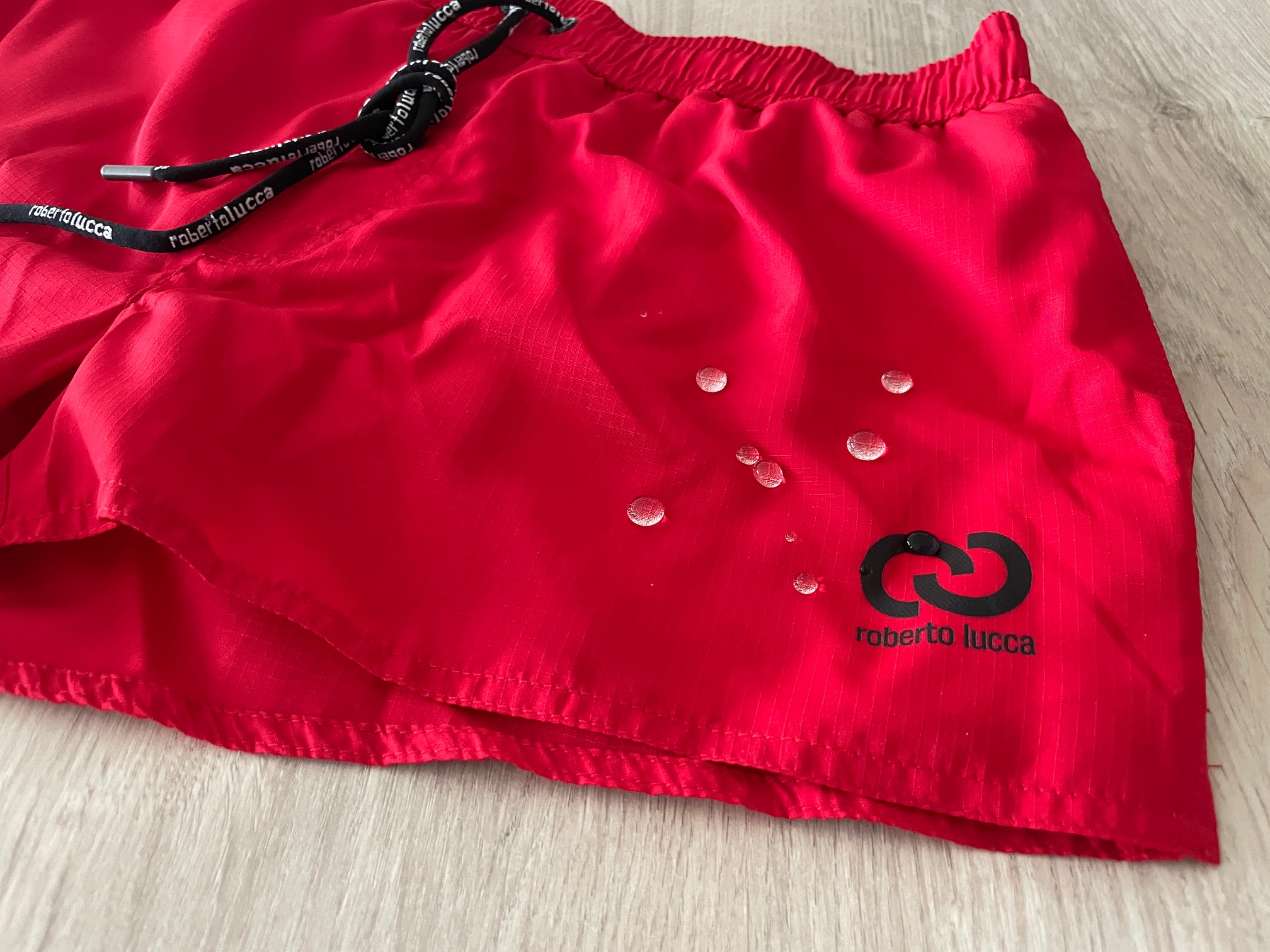
Close-up of Roberto Lucca swimwear Hi-Tech fabric — material structure designed for rapid moisture transport
In swimwear, material is the foundation — but not in a cheap marketing shortcut sense. When in contact with water, what matters is how the fabric behaves as a whole. The fibre type is important, but so is density, surface texture, structure, air permeability and the way the material absorbs and distributes water.
This means two pairs of swimwear can share a similar fibre base but behave differently after swimming. Some can spread moisture across a larger surface area, speeding up evaporation. Others retain water in more compact zones, slowing drying and leaving the user feeling cold and damp for longer. That is why it is not sensible to take the phrase "polyester swimwear" as an automatic confirmation of performance. What matters is whether it is a high-quality technical swim fabric, how it is engineered, and whether it maintains its behaviour after repeated use.
When searching for branded men”s swimwear, the customer is not just looking for a logo or a higher price point. They are looking for a model where a higher material standard, better fabric construction and more reliable behaviour in real use can be expected. A technically sound model does not stand out because it has an impressive word on its label — it stands out because it actually works after swimming. What specifically separates quality men”s swimwear from the average is explored in detail on our product pages.
Many customers look primarily at the appearance, length or brand when buying swimwear. From a drying perspective, however, the parameters that product photography almost never shows are critically important: fabric thickness, its weight per unit area and breathability. The thicker and heavier the material, the greater the volume available for temporarily retaining water. If breathability is also weaker, evaporation will be slower and the swimwear will feel heavier after swimming than its appearance would suggest.
This is one of the most important reasons why two pairs of swimwear can feel completely different after swimming even when they look similarly well-made at first glance. For a serious product, it is not enough to say the material is lightweight. What also matters is how much water remains in it after draining, how well air flows through it, and how quickly it can evaporate residual moisture.
When selecting branded men”s swimwear, it is therefore not enough to consider only design, brand or the material description. What is important is whether the entire model makes constructional sense. A quality waistband, appropriate fabric weight, functional breathability and the absence of unnecessarily dense details are just as important from a post-swim comfort perspective as the material name itself.
The cut fundamentally changes how much water the swimwear carries, how large the fabric area that gets wet is, and how moisture behaves during wear. With men”s swim shorts, there is by nature a larger fabric area — meaning a larger wet volume that the garment must manage after swimming. That does not have to be a problem if the fabric is reasonably lightweight, well breathable and the details are not unnecessarily complex.
In reality, however, shorts often include a drawstring channel, an inner mesh lining, more seam stitching and a firmer waistband. Each such detail can be a point where water is held longer. That is exactly why shorts often appear at first glance to shed water quickly, but when sitting or walking they remain damp precisely in the zones that determine comfort.
With shorter styles, length also comes into play. A smaller fabric area generally means a smaller volume of water that needs to be removed after swimming. With boxer-brief cuts, body contact becomes more significant — post-swim comfort therefore depends not only on evaporation into the air, but also on how quickly moisture decreases between the fabric and the skin. With brief models, there is the least material, and therefore the total wet volume tends to be low.
One of the most important things marketing often bypasses is the difference between drying freely hanging fabric and drying swimwear directly on the body. When fabric hangs freely, air reaches a larger portion of the surface and evaporation has better conditions. When swimwear is on the body, part of the surface is pressed against skin, airflow is weaker and some areas retain moisture longer.
The user therefore perceives comfort primarily through critical zones: waistband, lining, seat, inner layers and areas pressed against the skin for longer periods. From a practical standpoint, the more important question is "when does the swimwear stop being uncomfortable?" rather than "when is it completely dry?". This is a difference the customer feels immediately, even if they cannot articulate it in technical terms.
That is why, when making a wider choice of men”s swimwear, it does not pay off to consider only the appearance in a dry fitting room or on a product photograph. Far more important is how the material will behave in motion after swimming, when sitting, when walking, or when moving from the water to a sun lounger, a promenade or a car.
When it comes to fast drying, too much focus is placed on the new product. But the real user does not wear their swimwear just once. They submerge it in a pool, leave it to dry in the sun, take it to the sea, wash it and expose it to UV radiation again. Swimwear materials should therefore not be judged only by the first impression after unpacking, but also by how they behave after realistic use.
Chlorine, salt water and sun can gradually change the mechanical properties of the fabric, its dimensional stability and the overall material behaviour. This has a direct impact on drying as well. When material loses some of its elasticity over time or shape discipline worsens, areas form where water is retained longer than in a new model.
The waistband may stay wet longer than before, the inner layer may chill more and the fabric may no longer sit as cleanly on the body as at the start. That is why, from the customer”s perspective, not only the initial drying speed matters, but also whether the swimwear retains this ability after repeated use. This is precisely where the difference breaks between a standard seasonal product and a conscientiously designed model.
At a casual glance, a customer notices primarily the colour, length and overall cut of swimwear. In real drying, however, it is often the details that decide — details that do not seem important at first glance: the inner mesh, lining, waistband, drawstring channel, reinforced hems and areas with denser stitching. It is precisely here that water often stays longer than on the main fabric surface.
In practice this means a person can have the impression that the main section has almost dried, yet the waistband remains cold longer, the lining is still damp and the inner layers are distracting when walking. Every additional layer or material density creates a zone where moisture evaporates more slowly. These small technical points are exactly what separates an average model from a product that performs convincingly even after swimming.
When buying swimwear online, the customer cannot rely on touch or a post-swim trial. That makes it all the more important to be able to read a product description more technically. If a model only mentions a general sentence about fast drying, that is not enough. It says a great deal more when the text works with terms like lightweight technical swim fabric, stable waistband, functional breathability, chlorine and saltwater resistance.
A good description does not need to reveal the entire manufacturing process. It should, however, suggest that the manufacturer understands what they are selling. If a brand can explain why a given model is better suited to pools, why a shorter cut behaves more dynamically after swimming, or why shape stability matters in a specific model, that is a strong signal.

Roberto Lucca men”s swimwear in real conditions — pool, sea and thermal waters. How we test every model at DESSUE.
If there is one practical takeaway from the subject of fast drying, it is this: when it comes to swimwear, it is not enough to ask whether it is fast-drying. The right questions are: how does it behave after swimming, how quickly does it stop chilling, does it hold water in the waistband or inner layers, does it retain its shape after repeated use, and does the chosen cut match the intended purpose.
In a pool, chlorine and long-term stability play a bigger role. At sea and on holiday, salt water, UV and comfort when moving out of the water matter more. For sportier use, low wet volume and stability during movement are more important. That is exactly why branded men”s swimwear is the choice where behind the good appearance there is also technical substance — and the model performs reliably regardless of where the customer uses it.
Fast drying is not a marketing label. It is the functional result of how fabric works with water from the moment it gets wet to the evaporation of residual moisture. Absorption, transport, surface distribution, breathability, thickness, weight, body contact, cut and long-term resistance to chlorine, salt water and UV all play a role.
Truly functional men”s swimwear must therefore not just sound good in a product description. It must quickly reduce the sensation of wetness and cold after swimming, must not unnecessarily retain water in critical areas, and must maintain its behaviour after repeated use. If you are looking for branded men”s swimwear that works not only at first glance but after every subsequent swim — what always decides is the same thing: whether the model works as a complete system.
This article was written by DESSUE”s in-house product experts, drawing on 19 years of experience selecting, testing and selling men”s swimwear. All Roberto Lucca products are tested in real conditions: pools, sea and thermal waters.
It depends on several factors at once — cut (shorts dry slower than briefs), material thickness, breathability, temperature and whether the customer is moving or sitting. There is no exact time: the more important question is when the swimwear stops being uncomfortable to wear — not when it is completely dry in the open air.
The waistband is a point with multiple material layers, denser stitching and a drawstring channel. Every additional layer slows evaporation. Moreover, the waistband is partially pressed against skin during wear, which restricts airflow. That is exactly why quality swimwear uses a waistband of reasonable thickness and the simplest possible construction.
The best results are achieved with lightweight technical polyester fabrics with low area weight and good breathability. The key is not just the fibre type, but also the structural density and the way the material spreads moisture across the surface area.
Usually faster at sea — higher temperature, direct sun and sea breeze create better evaporation conditions. On the other hand, salt water can affect the material differently than chlorinated pool water with repeated use. That is why it is important to rinse swimwear with fresh water after every swim.
Quality men”s swimwear with worldwide delivery is available directly at Dessue.com. We offer Roberto Lucca models with proven technical materials and express delivery.
Náš obchod Vám doporučuje
Review of the e-shop
| 5 |  |
|
127x |
| 4 | |
|
6x |
| 3 | |
|
1x |
| 2 | |
|
1x |
| 1 | |
|
0x |
We guarantee the origin of reviews, which are verified by the e-shop and come only from users who have purchased this product.


Just recieved these and I can say they are a great product and made of top quality materials, well worth the price. Size M just fit me at 81kg. If you want a little loser fit go up one size. Snug fit around the thighs if thats the look your going for. Took about 4 weeks to arrive in Canada.

Just recieved these and I can say they are a great product and made of top quality materials, well worth the price. Size M just fit me at 81kg. If you want a little loser fit go up one size. Snug fit around the thighs if thats the look your going for. Took about 4 weeks to arrive in Canada.

▸ 2 products → –10% (code: 10OFF )
You can freely combine products.
(swimwear, underwear, clothing)
Apply the discount in the shopping cart.
(does not apply to discounted goods)


 Cookies settings
Our website uses cookies to help us improve it. In order for us to use cookies, you must allow us to do so. By clicking on the "OK, I agree" button, you grant this consent.
Settings OK I agreeCookies are small files that websites (including ours) store in your web browser. The contents of these files are exchanged between your browser and our servers or those of our partners. We need some cookies for the website to function properly, and some cookies are needed for marketing and statistical analytics. Here you can set which cookies we can use.
Souhlas můžete odmítnout here.


 420 234 076 045


