Category: Pánske plavky – materiály, strihy a technológie
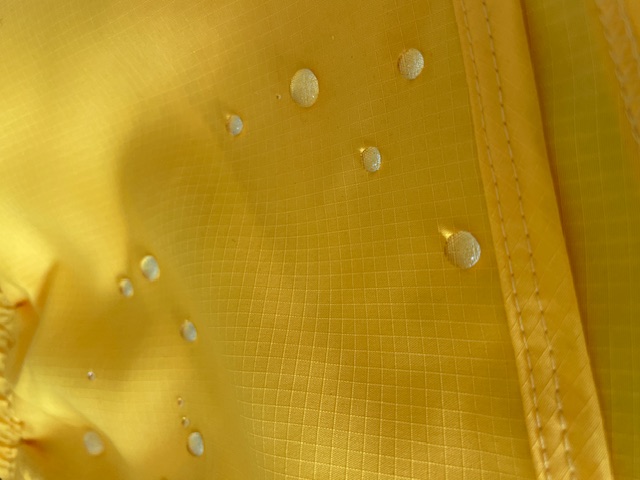
If a man wants to choose the right men”s swimwear for both the sea and the pool, it is not enough to consider only the design — material, durability and intended use are what matter most. When selecting, attention often focuses on cut, colour, leg length or how the model looks at first try-on. These are important factors, but in actual use they only partially decide. Whether swimwear retains its shape, elasticity and comfort after longer wear depends primarily on the environment in which it will be used. And this is exactly where the fundamental difference between pool and sea lies.
At first glance both involve nothing but water. From a material standpoint, however, pool and sea represent two significantly different operating loads. The pool means regular contact with chemically treated water — primarily chlorine, which puts long-term pressure on fibre resistance and material elasticity. The sea, by contrast, combines salt water, UV radiation, higher surface temperature, sand and repeated drying in the sun. In other words: the pool tests the chemical resistance of swimwear, the sea tests its surface, colour stability, quick-drying performance and ability to handle real summer use.
For a man who wants to buy quality men”s swimwear, asking whether he likes a particular model is not enough. The more important question is: in what conditions will the swimwear be used and what demands will real-world wear place on it.
Pool water is a controlled environment from a hygiene standpoint, but for textiles it is a long-term demanding operation. The decisive factor is the chemical treatment of the water — primarily chlorine. Chlorine is essential for pool safety, but it also gradually weakens the elastic components of the material and alters how the fabric behaves over time. This is exactly why regular swimmers often find that a model which initially fit precisely and compactly starts to feel softer, less stable and returns less precisely to its original shape after extended use.
This effect does not always appear immediately — and that is what makes pool exposure insidious. The material may show no problem after the first few visits, but after dozens of contacts with chlorinated water its behaviour begins to change. First elasticity decreases, then a weaker support feel emerges, and later the waistband behaviour or overall compactness during wear may change. In cheaper models this process comes faster. In better-made swimwear the course is slower and less pronounced.
For this reason, the material solution is of fundamental importance in pool swimwear. Not all swimwear fabrics respond to chemical stress the same way — some are designed more for visual effect, others for regular use. This is exactly where the difference lies between a model that looks good on the day of purchase and one that retains its functionality after a series of training sessions or repeated pool visits. What chlorine actually does to the material and how to manage it is explained in detail in our article What Chlorine Does to Swimwear and How It Affects Longevity.
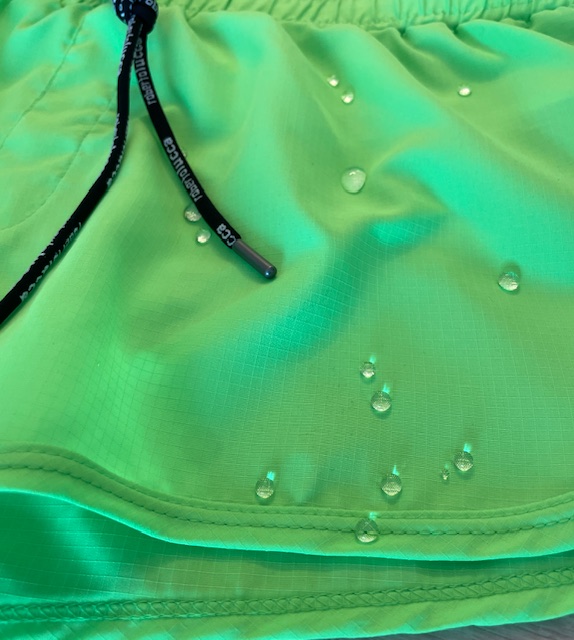
The sea environment is different in that it does not stress swimwear through a single dominant variable but through a combination of several factors. Saltwater alone may not have the same immediate effect on elasticity as chlorine, but in practice it is accompanied by UV radiation, higher temperature, repeated drying in the sun, sand and mechanical friction. This combination is exactly what makes the sea a materially very specific environment.
After swimming in the sea, salt remains in the material and on the fabric surface. If swimwear is not rinsed with clean water, the salt after drying alters the feel and can contribute to a stiffer sensation when wearing it next time. Moreover, it is not just about the chemical effect of salt — at the sea, swimwear regularly comes into contact with sand, sun loungers, towels, hot surfaces and long exposure to direct sunshine. The material is therefore stressed not only in the water but also outside it.
At the sea it quickly becomes clear whether the fabric is genuinely high quality. Better-made swimwear retains a more pleasant surface after drying, a more refined appearance and higher shape stability. A weaker model may look flat after one intensive holiday, feel rougher and lose some of its original precision.
When a man looks for branded men”s swimwear, real quality shows at the sea in how the swimwear handles a long day between water, sun and repeated drying without losing its level after a short time.
It is important to stress that while pool and sea both shorten the lifespan of a weaker model, they do so through different mechanisms. The pool more often exposes weaker chemical resistance and reduced shape stability. The sea tests fabric surface, colour durability, drying ability and the overall behaviour of the material after repeated wetting and drying.
At the pool a man more often notices over time that the swimwear holds less well, fits less precisely or no longer feels as compact as at the start. At the sea he is more likely to notice a surface change, lower fabric softness and sometimes less comfort during all-day wear.
This difference is fundamental in selection as well. A man who goes to the pool regularly expects different performance from swimwear than a man who uses it mainly for summer holidays and wellness. In the first case, chemical resistance and shape stability carry more weight. In the second case, the importance of quick-drying, comfort outside the water and material behaviour after drying becomes more apparent. Why swimwear loses its shape over time and what is connected to this is explained in our article Why Swimwear Loses Its Shape Over Time – And Which Styles Do Not.
Quick-drying is often cited as a given with swimwear, but in practice it is one of the most important functional parameters. It is not just about the swimwear not feeling completely wet to the touch after a while. True quick-drying means low water absorption, the material”s ability to move water away from the surface and a construction that does not retain unnecessary moisture volume.
In the pool, quick-drying increases comfort after swimming, during transitions and with repeated use throughout a day. At the sea this parameter matters even more — slow drying means longer salt contact with the material, longer moisture exposure and greater discomfort when moving outside the water. If a weaker liner solution, less thought-out pockets or heavier material are added to this, the swimwear can be uncomfortable, cold against the body for longer and less suitable for all-day wear.
This is why quick-drying men”s swimwear does not just mean a marketing slogan — it means a real functional benefit that directly affects comfort, practicality and long-term material behaviour. How quick-drying works physically and why it differs from model to model is explained in detail in our article How Fast Drying Works in Practice (Not Marketing).
In close-fitting swimwear, material matters even more than in looser shorts. Brief swimwear, boxer swimwear and thongs sit very close to the body, so fabric quality shows immediately. Every material weakness appears sooner: in feel, stability, comfort and visual impression after drying.
In these cuts it is important that the fabric is not only elastic but also refined to the touch, shape-stable and capable of handling prolonged water contact without losing quality. Better technical swimwear fabric shows in the fact that it does not feel cheap when wet, does not stiffen unnecessarily when dry and remains comfortable even during longer skin contact.
When a man selects premium men”s swimwear, luxury should not be understood as just a higher price or bolder design. True luxury in swimwear also means that the material behaves more refinedly over time, holds its shape better, does not lose quality after drying and retains a dignified appearance and comfort with repeated use.
At the sea, one more factor comes into play that is often overlooked when choosing swimwear: UV load. For textiles in general, wet or stretched fabric may offer less protection than dry and stable fabric. At the same time, the density and quality of the material matter not only from a comfort standpoint but also in terms of how the fabric handles long hours in the sun.
For swimwear this means that with sea models, the material question cannot be separated from the usage question. A model that will be on the body for long hours on a sunny day needs a different functional foundation than a model intended for short indoor swimming. This also explains why some beach models deteriorate visually and materially faster — it is not just about the salt, but about the combination of salt, sun, heat, moisture and material stretching.
When comparing sea and pool, fabric alone is not enough to consider. Cut itself also plays a role. Briefs, boxer swimwear, thongs and men”s swim shorts stress the material differently, sit differently on the body and behave differently after leaving the water.
More close-fitting models tend to be advantageous for swimming as they offer less water resistance and change less in movement — which is why the pool user often prefers more compact concepts. At the sea and during all-day wear, however, more factors come into play: comfort outside the water, quick-drying, air circulation and the overall lifestyle effect. Shorts prevail here more often, but only when they are technically sensibly made and do not retain unnecessary water.
With brief and boxer models, it is more visible whether the fabric works with quality — since they sit closer to the body, every shortcoming shows sooner in feel, stability and visual impression. This is why these models have higher material quality requirements.
Many men want one pair of swimwear for everything: pool, sea, wellness and a regular summer day. Such a model exists, but it does not happen by chance. It needs balanced material, sensible quick-drying performance, a firm waistband, quality seams and behaviour that holds up after getting wet and after drying. It needs to handle pool chemistry and the combination of salt and sun while not feeling cumbersome outside the water.
Universal swimwear therefore cannot be just a compromise in the sense of "it”ll somehow manage". It needs to be constructively balanced so it does not deliver excellent performance only in one situation and poor performance in another. This is exactly where space opens for better-made models in which functionality is connected with cut, material and aesthetics. How to choose the right model according to your body shape and purpose is explained in our article How to Choose Men”s Swimwear According to Your Body Shape.
If a man swims regularly in a pool and also spends holidays by the sea, from a practical standpoint it is often wiser to have two pairs of swimwear. One can be more pool- or sport-oriented, with an emphasis on stability and chlorine resistance. The other can be holiday or lifestyle-oriented, designed with greater emphasis on quick-drying, lightness and comfort for all-day wear.
This solution is not excessive or an unnecessary expense. On the contrary — two purpose-chosen pairs of swimwear can overall work out cheaper than one "universal" model that wears out faster in both environments precisely because it is not optimally designed for either.
A man who goes to the pool three times a week and to the sea once a year will have different priorities from a man who swims occasionally and spends a longer active holiday by the sea. That is exactly why there is no universal recipe — there is only a responsible reflection on where and how the swimwear will actually be used.
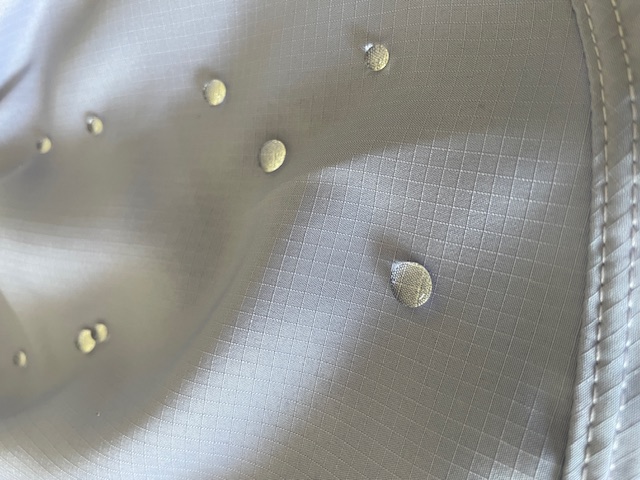
Regardless of whether swimwear is intended for sea or pool, proper care significantly extends its lifespan. For pool swimwear the most important step is simple: rinse with cold fresh water immediately after every swim. Chlorine continues its chemical reaction with the material even after leaving the water — as long as the fabric is wet and contains chlorinated water, degradation continues. Rinsing stops it.
The same rule applies to sea swimwear — rinse after every swim so that salt is not left to dry directly on the material. Do not dry swimwear in direct sunlight or on a radiator. Do not wash with aggressive detergents or in hot water. Do not fold wet swimwear into a closed bag — a damp environment extends the time chlorine or salt acts on the fibre.
At DESSUE we have tested hundreds of models in real conditions over 19 years — pool, sea, thermal waters and everyday wear. We know that the difference between swimwear that lasts one season and Roberto Lucca models that perform the same way after three seasons is not only in the material. It is also in how the user treats them after every swim.
Pool and sea are not just two ways to get wet. They are two different operating loads that test swimwear through different mechanisms and reveal different weaknesses. The pool tests primarily chemical resistance and shape stability of the material. The sea tests surface, colour durability, quick-drying and overall resistance to the combination of salt, UV and heat.
A man who knows this can choose much more wisely. Either he selects one balanced model that handles both — but only if it is genuinely quality-designed. Or he gets two pairs purpose-specifically — and will be satisfied with each pair for longer.
What he should always watch for when choosing: material composition and its real durability, quality of waistband and seam construction, quick-drying capability and behaviour after drying. These parameters say more about swimwear than any photograph or marketing sentence. The full range of men”s swim shorts and other Roberto Lucca styles is available at Dessue.com with worldwide delivery.
This article was written by DESSUE”s in-house product experts, drawing on 19 years of experience selecting, testing and selling men”s swimwear. All Roberto Lucca products are tested in real conditions: pools, sea and thermal waters.
Yes, if they are quality-designed from balanced material with chlorine resistance and good resistance to saltwater and UV. Cheaper models wear out faster in one or both environments. For intensive pool swimming and active sea holidays it is more practical to have two pairs.
It depends on frequency and material. The pool damages material faster during regular swimming thanks to chlorine. The sea is more aggressive with the combination of salt, UV and heat, but usually in shorter intensive periods. At the same frequency, the pool is more demanding on the material.
The combination of saltwater, UV radiation, heat and repeated drying in the sun degrades the material surface and dyes. If swimwear is not rinsed after every swim and dries directly in the sun, this process accelerates significantly. Immediate rinsing with fresh water and drying in the shade help.
Functionally, briefs and boxer swimwear are more suitable for regular pool swimming — less material surface means less wet volume and less chlorine contact. Shorts are more of a lifestyle choice suitable primarily for recreational swimming and sea holidays.
Look in the product description for: chlorine-resistant or Hi-Tech polyester, mention of saltwater and UV resistance, sensible quick-drying and quality waistband construction. If this information is absent, the swimwear most likely lacks special material for demanding environments.
Yes — at the sea, material quality shows very quickly. A cheap model loses surface, colour and shape after an intensive holiday. Quality swimwear retains its level even after repeated swims in saltwater and long hours in the sun. Long-term, it is the more economical choice.
At Dessue.com you will find Roberto Lucca men”s swimwear in Hi-Tech materials with proven resistance to chlorine, saltwater and UV radiation — including a wide range of men”s swim shorts. Worldwide delivery available.
Náš obchod Vám doporučuje
Review of the e-shop
| 5 |  |
|
127x |
| 4 | |
|
6x |
| 3 | |
|
1x |
| 2 | |
|
1x |
| 1 | |
|
0x |
We guarantee the origin of reviews, which are verified by the e-shop and come only from users who have purchased this product.


Just recieved these and I can say they are a great product and made of top quality materials, well worth the price. Size M just fit me at 81kg. If you want a little loser fit go up one size. Snug fit around the thighs if thats the look your going for. Took about 4 weeks to arrive in Canada.

Just recieved these and I can say they are a great product and made of top quality materials, well worth the price. Size M just fit me at 81kg. If you want a little loser fit go up one size. Snug fit around the thighs if thats the look your going for. Took about 4 weeks to arrive in Canada.

▸ 2 products → –10% (code: 10OFF )
You can freely combine products.
(swimwear, underwear, clothing)
Apply the discount in the shopping cart.
(does not apply to discounted goods)


 Cookies settings
Our website uses cookies to help us improve it. In order for us to use cookies, you must allow us to do so. By clicking on the "OK, I agree" button, you grant this consent.
Settings OK I agreeCookies are small files that websites (including ours) store in your web browser. The contents of these files are exchanged between your browser and our servers or those of our partners. We need some cookies for the website to function properly, and some cookies are needed for marketing and statistical analytics. Here you can set which cookies we can use.
Souhlas můžete odmítnout here.


 420 234 076 045


